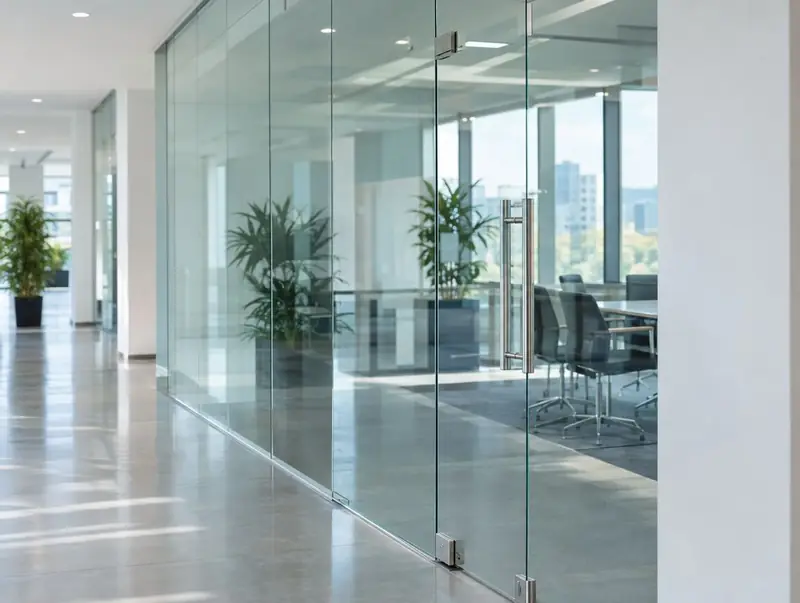
What is toughened safety glass?
Toughened safety glass is ordinary glass that has been heated and rapidly cooled so its surface is held in compression, making it four to five times stronger than annealed glass of the same thickness. If it does break, it shatters into small, relatively blunt pieces instead of sharp shards, which is why it is used in doors, low-level panes and frameless partitions.
Toughened glass is made to BS EN 12150 and is the standard choice where people could walk into the glass. It is strong against knocks, wind load and heat, and it is the usual outer pane of a modern double-glazed unit. It is also the glass used for frameless doors, shower screens and glass partitions in offices.
It is not a security glass on its own. When toughened glass breaks, the whole pane collapses into small pieces and the opening is left clear, so it does nothing to stop someone climbing through. Where you need safety and security together, the answer is laminated glass, or a sealed unit with a toughened outer pane and a laminated inner pane. Toughened glass also cannot be cut or drilled after toughening, so every pane is made to exact size, and for large or overhead panes a heat-soak test reduces the small risk of spontaneous breakage.
How much does toughened safety glass cost?
Our guide range is £114 to £414 including VAT (£95 to £345 plus VAT) per pane, supplied and fitted. The exact figure depends on size, glass makeup, frame condition and access, and your fixed price is confirmed in writing after the free survey. See all glass prices.
Specification and options
- Made to BS EN 12150 and marked for identification
- Breaks into small blunt fragments
- Four to five times the strength of annealed glass
- Clear, tinted, obscure, low-iron and sandblasted finishes
- Holes, notches and polished edges for frameless fittings
- Heat-soaked option for large and overhead panes
- Single panes or the outer pane of a sealed unit
- Made to measure for each opening
Where toughened safety glass is used
- Glazed doors and side panels
- Panes below 800 mm in homes and offices
- Frameless office partitions and doors
- Shower screens and splashbacks
- Balustrades in a laminated toughened makeup
What to decide before you order
Toughened or laminated
Toughened gives strength and safe breakage. Laminated gives safe breakage and stays in place, which is what security needs. Many doors use both in one sealed unit.
Heat soaking
Rare nickel sulphide inclusions can make toughened glass break without warning. Heat soaking reduces the risk and is worth specifying for large, high or overhead panes.
Measure once, carefully
Toughened glass cannot be cut afterwards, so holes and sizes are fixed at the factory. Accurate survey measurements avoid remakes.
Barriers and balustrades
Glass that acts as a barrier usually needs a laminated toughened makeup so it stays in place if one ply breaks.
Rules across the UK
Safety glazing, building regulations, planning and listed building rules differ between England, Wales, Scotland and Northern Ireland. These are the points most relevant to toughened safety glass; local pages show the version for your nation.
Safety glass in critical locations
In England, section 5 of Approved Document K treats glazing in doors and in side panels within 300 mm of a door edge, from floor level up to 1,500 mm, and any other glazing below 800 mm, as a critical location. Glass there should break safely, be robust, or be guarded. Laminated or toughened glass meeting BS EN 12600 class 3 is the usual answer, rising to class 2 for door and side-panel panes wider than 900 mm.
Glazing in workplaces
Regulation 14 of the Workplace (Health, Safety and Welfare) Regulations 1992 requires windows and transparent surfaces in walls, partitions, doors and gates to be of safety material or protected against breakage where health or safety makes that necessary, and to be marked so people notice them. The employer or the person in control of the premises decides what is needed through their risk assessment.
Replacing glass in an existing frame
Replacing only the glass or sealed unit in an existing frame is generally treated as a repair in England rather than notifiable building work. Replacing a whole window or door is notifiable and is normally certified through a competent person scheme or approved by building control. Either way, new glass in a critical location should still be safety glass.
How it works
Tell us what needs securing
Use the guide price tool or form, or call. Pane sizes and a few photos help us give a guide figure straight away.
Free survey
A surveyor measures each pane, checks the existing glass, frame and beads, and talks through the rating that suits the risk.
Fixed price in writing
You get a written quote listing each pane, the glass type and class, the price and the lead time. Nothing is ordered until you accept.
Made to measure and fitted
Glass is made to order and fitted by glaziers working under our contract with you, then cleaned, checked and explained.
Toughened safety glass: questions
How much does toughened glass cost?
Most toughened safety glass panes cost from £95 to £345 plus VAT (£114 to £414 inc VAT) supplied and fitted, depending on size, thickness and finish. Frameless doors and drilled panes cost more. Your fixed price follows a free survey.
Is toughened glass a security glass?
No. Toughened glass is strong and breaks safely, but once broken the pane falls out and leaves the opening clear. For security, choose laminated glass or a unit with a laminated pane.
Where must safety glass be used?
In critical locations: in England, Approved Document K covers glazing in and beside doors up to 1,500 mm from the floor and other glazing below 800 mm; Wales has the same idea in its Approved Document N, Scotland in standard 4.8 and Northern Ireland in Part V. Glass there must be safety glass or protected.
Can toughened glass be cut to fit?
No. Cutting or drilling toughened glass makes it shatter, so every pane, hole and notch is made to size before toughening.
Why did my toughened glass break on its own?
Occasionally a tiny nickel sulphide inclusion or edge damage causes spontaneous breakage. Heat-soak tested glass reduces the risk for large or high panes.
How can I tell if glass is toughened?
Look for a permanent mark etched in a corner naming the standard. Polarised sunglasses can also show faint patterns in toughened glass. We can check during the survey.
Find toughened safety glass near you
Choose your county or region for local information and the rules that apply where you are.
England
- Bedfordshire
- Berkshire
- Bristol
- Buckinghamshire
- Cambridgeshire
- Cheshire
- Cornwall
- Cumbria
- Derbyshire
- Devon
- Dorset
- Durham
- East Riding of Yorkshire
- East Sussex
- Essex
- Gloucestershire
- Greater London
- Greater Manchester
- Hampshire
- Herefordshire
- Hertfordshire
- Isle of Wight
- Kent
- Lancashire
- Leicestershire
- Lincolnshire
- Merseyside
- Norfolk
- North Yorkshire
- Northamptonshire
- Northumberland
- Nottinghamshire
- Oxfordshire
- Rutland
- Shropshire
- Somerset
- South Yorkshire
- Staffordshire
- Suffolk
- Surrey
- Tyne and Wear
- Warwickshire
- West Midlands
- West Sussex
- West Yorkshire
- Wiltshire
- Worcestershire
Wales
Scotland
- Aberdeen, Aberdeenshire and Moray
- Highland
- Dundee and Angus
- Perth and Kinross
- Fife
- Edinburgh and the Lothians
- Forth Valley
- Glasgow and Clyde
- Lanarkshire
- Ayrshire
- Argyll and Bute
- Dumfries and Galloway
- Scottish Borders
- Orkney, Shetland and the Western Isles