The short answer
Both are safety glass, but they break differently. Toughened glass shatters into small, blunt pieces and leaves an open hole; laminated glass cracks but stays in the frame because a plastic interlayer holds the pieces together. For security, laminated is the one to choose.
How is toughened glass made?
Toughened glass is ordinary float glass cut to size, edge-worked, heated to around 620°C and then cooled quickly with jets of air. The process locks the surfaces in compression, making the pane roughly four to five times stronger than untreated glass of the same thickness. It is made to BS EN 12150.
Because the stresses are locked in, toughened glass cannot be cut, drilled or edge-worked afterwards. Every pane has to be ordered at its final size, which is why a broken toughened pane cannot simply be trimmed from stock.
How is laminated glass made?
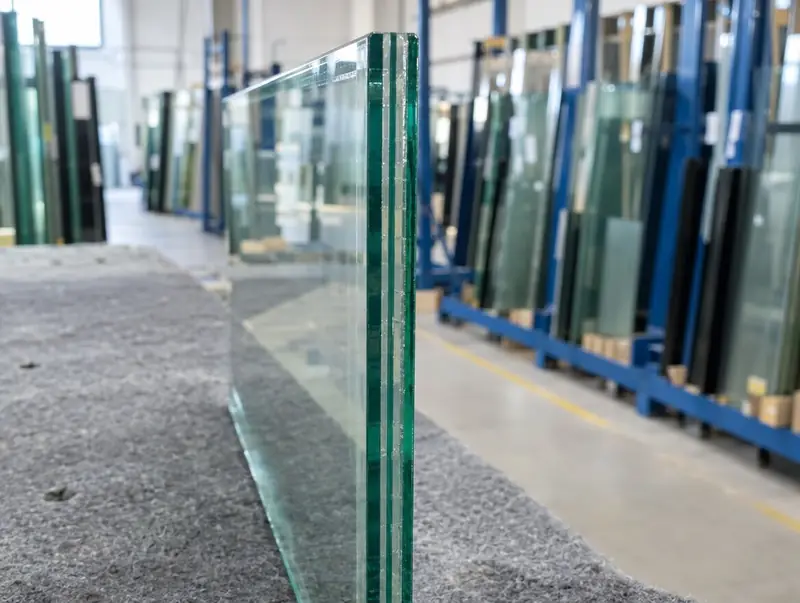
Laminated glass is two or more sheets of glass bonded together with an interlayer, most often polyvinyl butyral (PVB) in thicknesses such as 0.38 mm or 0.76 mm, under heat and pressure. Stiffer ionoplast interlayers are used where the glass must carry load after breaking.
When laminated glass is struck, the glass cracks but the fragments stay stuck to the interlayer. The pane stays in place, keeps out the weather and has to be attacked again and again to make a hole.
Which is better for security?
Laminated. Toughened glass is strong against a single blow, but once broken it collapses out of the frame and leaves a clear opening. A burglar can break it quickly with a small sharp tool. Laminated glass can be rated for resistance to manual attack under BS EN 356, from P1A for homes up to P8B for high-risk shops.
Which is better for safety in doors and low windows?
Both can meet the safety rules for critical locations, such as glass in doors and glass below 800 mm, as long as the pane is the right impact class for its size. Toughened breaks into small pieces that are unlikely to cause deep cuts; laminated cracks but stays put, which also stops people falling through. In doors and side panels a common choice is toughened on the outside and laminated on the inside of a sealed unit.
How do they compare at a glance?
- Strength against a single impact: toughened is stronger
- When broken: toughened falls out in small pieces; laminated cracks and stays in the frame
- Cutting on site: laminated can usually be cut to size; toughened cannot
- Security rating: laminated can be tested to BS EN 356; toughened on its own cannot
- Noise: laminated, especially with acoustic interlayers, cuts more sound
- Sunlight: a PVB interlayer screens out most ultraviolet light, which helps reduce fading
Can you combine the two?
Yes. Toughened sheets can themselves be laminated together, which gives strength and post-breakage hold, and double-glazed units can mix a toughened pane with a laminated one. The survey decides the makeup from the location, the risk and the frame.
Sources
- Approved Document K: protection from falling, collision and impact (GOV.UK)
- Building standards technical handbook 2022, domestic: 4.8 danger from accidents (gov.scot)
- BS EN 356:2000 Glass in building. Security glazing. Resistance against manual attack (BSI)
This guide is general information, not legal advice. Rules differ between England, Wales, Scotland and Northern Ireland; check with your council, building control or insurer where it matters.
Add Security Glazing UK as a preferred source on Google
Related glass types
Two or more sheets of glass bonded with a tough interlayer, so a broken pane stays in the frame instead of falling out.
from £174 inc VATLearn moreHeat-treated glass several times stronger than ordinary glass that breaks into small blunt pieces, for doors, low panes and partitions.
from £114 inc VATLearn moreSealed double-glazed units with a laminated pane, made to fit your existing frames and slow down break-ins.
from £174 inc VATLearn moreUpgrading the glass in existing windows, doors and screens to laminated security glass without replacing the frames.
from £174 inc VATLearn more