What is bullet-resistant glass?
Bullet-resistant glass is a thick laminated composite of glass, interlayers and often polycarbonate that is tested to stop specific firearms under BS EN 1063. The class, from BR1 to BR7 plus the shotgun classes SG1 and SG2, describes the weapon and ammunition the glass has been shown to stop. Ratings belong to the manufacturer's tested product, and their test evidence comes with your quote.
Each BS EN 1063 class is tied to a weapon: BR1 is a .22 rifle, BR2 a 9 mm handgun, BR3 a .357 Magnum, BR4 a .44 Magnum, BR5 a 5.56 mm rifle, BR6 a 7.62 mm rifle and BR7 a 7.62 mm round with a hardened steel core. A suffix of NS means no glass splinters came off the protected face in the test; S means some did, which matters if staff sit close behind the screen.
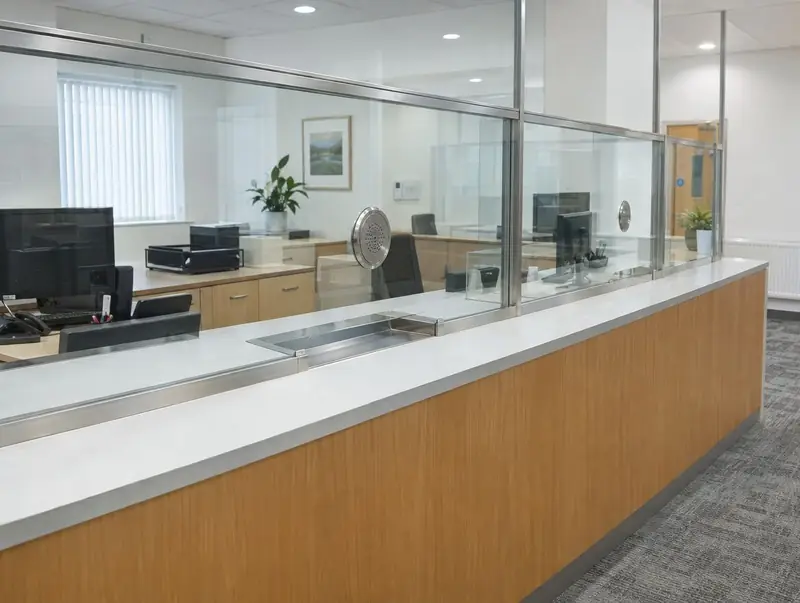
The level is never picked from a brochure. It should come from a risk assessment of who uses the space, what is being protected and what threat is realistic, and the whole system has to match: glass, frame, joints, transaction trays and the wall around it. A BR4 pane in an unrated frame or next to a plasterboard wall leaves an easier route. We work to the specification from your risk assessment and quote the manufacturer's tested glazing and framing for it.
How much does bullet-resistant glass cost?
Our guide range is £995 to £2,995 plus VAT (£1,194 to £3,594 inc VAT) per m², supplied and fitted. The exact figure depends on size, glass makeup, frame condition and access, and your fixed price is confirmed in writing after the free survey. See all glass prices.
Specification and options
- BS EN 1063 classes BR1 to BR7 and SG1 or SG2
- NS (no-splinter) makeups for staff working close to the glass
- Glass-clad polycarbonate options to save weight
- Matching rated frames, joints and transaction trays
- Speech panels and deal trays that keep the protection continuous
- Single panes or sealed units for external use
- Built to the specification from your risk assessment
- Manufacturer's test evidence supplied with your quote
Where bullet-resistant glass is used
- Bank, building society and post office counters
- Bureaux de change and cash offices
- Petrol station night-pay windows
- Security gatehouses and control rooms
- Secure reception points in public buildings
What to decide before you order
Which BR class
Most UK counters that need ballistic protection specify a handgun class such as BR2 to BR4. Rifle classes are for specialist sites where a threat assessment calls for them.
S or NS
If staff sit within arm's reach of the glass, specify NS so that no splinters come off the inside face.
The rest of the screen
Frames, joints, trays and the wall below the counter must give matching protection, or the weakest part decides the real level.
Weight and structure
Ballistic glass is very heavy. The counter, floor and fixings must carry it, and some sites need a lighter glass-clad polycarbonate makeup.
Rules across the UK
Safety glazing, building regulations, planning and listed building rules differ between England, Wales, Scotland and Northern Ireland. These are the points most relevant to bullet-resistant glass; local pages show the version for your nation.
Glazing in workplaces
Regulation 14 of the Workplace (Health, Safety and Welfare) Regulations 1992 requires windows and transparent surfaces in walls, partitions, doors and gates to be of safety material or protected against breakage where health or safety makes that necessary, and to be marked so people notice them. The employer or the person in control of the premises decides what is needed through their risk assessment.
Insurer requirements
Insurers set their own conditions for shops, offices, stock and cash, and some name a glazing class such as BS EN 356 P6B in the policy wording. Ask for that wording in writing before you order. The insurer decides whether the glass meets their policy; we provide the glass manufacturer's test evidence with the quote.
Planning permission
Changing the glass in an existing window or shopfront does not usually need planning permission, because the building looks much the same afterwards. A new or altered shopfront, or security features added to the outside of a building, may need planning permission from the council. Bollards or barriers on the pavement need the highway authority's consent, which is normally the council.
How it works
Tell us what needs securing
Use the guide price tool or form, or call. Pane sizes and a few photos help us give a guide figure straight away.
Free survey
A surveyor measures each pane, checks the existing glass, frame and beads, and talks through the rating that suits the risk.
Fixed price in writing
You get a written quote listing each pane, the glass type and class, the price and the lead time. Nothing is ordered until you accept.
Made to measure and fitted
Glass is made to order and fitted by glaziers working under our contract with you, then cleaned, checked and explained.
Bullet-resistant glass: questions
How much does bullet-resistant glass cost?
Bullet-resistant glass usually costs from £995 to £2,995 plus VAT (£1,194 to £3,594 inc VAT) per square metre supplied and fitted, depending on class, makeup and size. Complete counter screens with frames and trays are priced as a system after a free survey.
Can any glass stop every bullet?
No. Glass is tested to resist particular weapons and ammunition, which is why it is called bullet-resistant and given a BS EN 1063 class rather than described as stopping everything.
How do I know which BR class I need?
From a risk assessment of your site, often done by your security adviser, insurer or head office. We then quote glass and framing tested to that class.
What does NS mean on bullet-resistant glass?
NS means no splinters came off the protected face during the test. S means some fragments did. NS is the safer choice where people sit close behind the glass.
Can you fit bullet-resistant glass into existing frames?
Rarely. Ballistic glass is thick and heavy and its rating depends on a frame tested with it. In most cases the frame and glass are replaced together.
How thick is bullet-resistant glass?
It ranges from around 20 mm for lower handgun classes to well over 50 mm for rifle classes, depending on the manufacturer's makeup and whether polycarbonate is used.
Find bullet-resistant glass near you
Choose your county or region for local information and the rules that apply where you are.
England
- Bedfordshire
- Berkshire
- Bristol
- Buckinghamshire
- Cambridgeshire
- Cheshire
- Cornwall
- Cumbria
- Derbyshire
- Devon
- Dorset
- Durham
- East Riding of Yorkshire
- East Sussex
- Essex
- Gloucestershire
- Greater London
- Greater Manchester
- Hampshire
- Herefordshire
- Hertfordshire
- Isle of Wight
- Kent
- Lancashire
- Leicestershire
- Lincolnshire
- Merseyside
- Norfolk
- North Yorkshire
- Northamptonshire
- Northumberland
- Nottinghamshire
- Oxfordshire
- Rutland
- Shropshire
- Somerset
- South Yorkshire
- Staffordshire
- Suffolk
- Surrey
- Tyne and Wear
- Warwickshire
- West Midlands
- West Sussex
- West Yorkshire
- Wiltshire
- Worcestershire
Wales
Scotland
- Aberdeen, Aberdeenshire and Moray
- Highland
- Dundee and Angus
- Perth and Kinross
- Fife
- Edinburgh and the Lothians
- Forth Valley
- Glasgow and Clyde
- Lanarkshire
- Ayrshire
- Argyll and Bute
- Dumfries and Galloway
- Scottish Borders
- Orkney, Shetland and the Western Isles