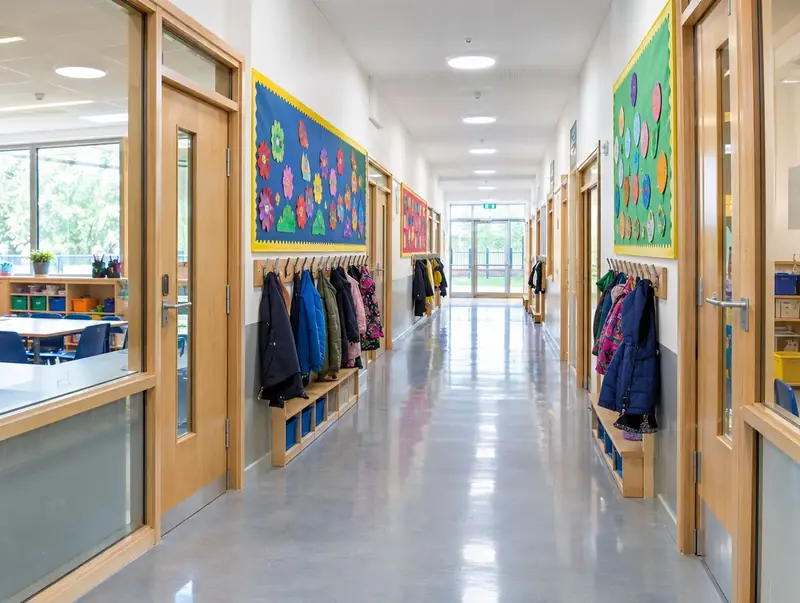
What is safety glazing for schools and public buildings?
Safety glazing for schools and public buildings means finding glass in critical locations, such as doors, side panels and low-level panes, that would break dangerously, and replacing it with toughened or laminated safety glass or protecting it with safety film. It helps duty holders meet workplace and building safety rules where children, staff and visitors move around.
Older schools, halls and offices often still have annealed or wired glass at low level and in doors. Wired glass looks strong, but the wire does not make it a safety glass, and in impact positions it can break into sharp pieces. Under the Workplace (Health, Safety and Welfare) Regulations 1992, glass in walls, partitions and doors must be of a safety material or protected where that is needed for health and safety, and building regulations set out the critical locations where new glazing has to be safe.
We survey and schedule each pane in the areas you want reviewed, note what glass is there and recommend a fix: toughened or laminated replacement, safety film, or guarding. Where glass is in a fire door or fire screen, it must stay fire-rated glass, so those panes get fire-rated safety glass rather than a plain swap. Work can be planned for holidays and weekends to keep disruption down.
How much does safety glazing for schools and public buildings cost?
Our guide range is £95 to £345 plus VAT (£114 to £414 inc VAT) per pane, supplied and fitted. The exact figure depends on size, glass makeup, frame condition and access, and your fixed price is confirmed in writing after the free survey. See all glass prices.
Specification and options
- Pane-by-pane survey and schedule of critical locations
- Toughened and laminated replacement glass
- Safety film for glass that can stay
- Fire-rated glass for fire doors and screens, using the glazing system named in the door's certification
- Manifestation markings on large clear panes
- Work in holidays and outside hours
- Laminated glass for vision panels and corridors
- Clear records for your estate files
Where safety glazing for schools and public buildings is used
- Primary and secondary schools
- Nurseries and early-years settings
- Colleges and community halls
- Libraries, leisure centres and council buildings
- Offices with older internal glazing
What to decide before you order
Replace or film
Replacement suits panes in poor frames or high-risk positions. Film is a quick, lower-cost way to protect sound glass in good frames.
Fire-rated panes
Glass in fire doors and screens must stay fire-rated. We use the fire-rated glass and glazing system named in the door or screen's certification or test evidence, never plain laminated glass, and some doors need a certificated fire-door installer.
Prioritising
Start with doors, side panels and low-level glass in busy areas, then work outwards. The schedule makes it easy to phase.
Manifestation
Large clear panes need markings at eye level so people do not walk into them.
Rules across the UK
Safety glazing, building regulations, planning and listed building rules differ between England, Wales, Scotland and Northern Ireland. These are the points most relevant to safety glazing for schools and public buildings; local pages show the version for your nation.
Glazing in workplaces
Regulation 14 of the Workplace (Health, Safety and Welfare) Regulations 1992 requires windows and transparent surfaces in walls, partitions, doors and gates to be of safety material or protected against breakage where health or safety makes that necessary, and to be marked so people notice them. The employer or the person in control of the premises decides what is needed through their risk assessment.
Safety glass in critical locations
In England, section 5 of Approved Document K treats glazing in doors and in side panels within 300 mm of a door edge, from floor level up to 1,500 mm, and any other glazing below 800 mm, as a critical location. Glass there should break safely, be robust, or be guarded. Laminated or toughened glass meeting BS EN 12600 class 3 is the usual answer, rising to class 2 for door and side-panel panes wider than 900 mm.
Fire-rated glass is different
Glass in fire doors, fire screens and protected escape routes has to be fire-rated glass tested as part of that door or screen system, under Approved Document B and the fire safety duties of the building's responsible person. Laminated and security glass are not fire-rated unless the product says so. Where a pane needs both fire and security performance, it must be a product tested for both.
How it works
Tell us what needs securing
Use the guide price tool or form, or call. Pane sizes and a few photos help us give a guide figure straight away.
Free survey
A surveyor measures each pane, checks the existing glass, frame and beads, and talks through the rating that suits the risk.
Fixed price in writing
You get a written quote listing each pane, the glass type and class, the price and the lead time. Nothing is ordered until you accept.
Made to measure and fitted
Glass is made to order and fitted by glaziers working under our contract with you, then cleaned, checked and explained.
Safety glazing for schools and public buildings: questions
How much does school safety glazing cost?
Replacing a typical pane with safety glass costs from £95 to £345 plus VAT (£114 to £414 inc VAT) supplied and fitted, depending on size, glass type and access. Safety film can cost less. A pane-by-pane quote follows a free survey.
Is wired glass safety glass?
Not usually. Ordinary wired glass is not a safety glass and can break into sharp pieces in impact positions. Some wired glass is used for fire resistance, which is a different job.
What are critical locations?
Glazing in and beside doors up to 1,500 mm from the floor and other glazing below 800 mm, in the English guidance. Similar rules apply in Wales, Scotland and Northern Ireland.
Do we have to replace all the old glass?
Not necessarily. The duty is to make glass safe where needed. That may mean replacement, film or guarding, depending on the pane and the risk.
Can you work during school holidays?
Yes. Most school glazing work is planned for holidays, weekends or after hours.
Can you replace glass in fire doors?
Often, yes, using the fire-rated glass and glazing system named in the door's certification or test evidence; some doors need a certificated fire-door installer, which we check first. Fire door glass must never be replaced with ordinary safety or security glass.
Find safety glazing for schools and public buildings near you
Choose your county or region for local information and the rules that apply where you are.
England
- Bedfordshire
- Berkshire
- Bristol
- Buckinghamshire
- Cambridgeshire
- Cheshire
- Cornwall
- Cumbria
- Derbyshire
- Devon
- Dorset
- Durham
- East Riding of Yorkshire
- East Sussex
- Essex
- Gloucestershire
- Greater London
- Greater Manchester
- Hampshire
- Herefordshire
- Hertfordshire
- Isle of Wight
- Kent
- Lancashire
- Leicestershire
- Lincolnshire
- Merseyside
- Norfolk
- North Yorkshire
- Northamptonshire
- Northumberland
- Nottinghamshire
- Oxfordshire
- Rutland
- Shropshire
- Somerset
- South Yorkshire
- Staffordshire
- Suffolk
- Surrey
- Tyne and Wear
- Warwickshire
- West Midlands
- West Sussex
- West Yorkshire
- Wiltshire
- Worcestershire
Wales
Scotland
- Aberdeen, Aberdeenshire and Moray
- Highland
- Dundee and Angus
- Perth and Kinross
- Fife
- Edinburgh and the Lothians
- Forth Valley
- Glasgow and Clyde
- Lanarkshire
- Ayrshire
- Argyll and Bute
- Dumfries and Galloway
- Scottish Borders
- Orkney, Shetland and the Western Isles