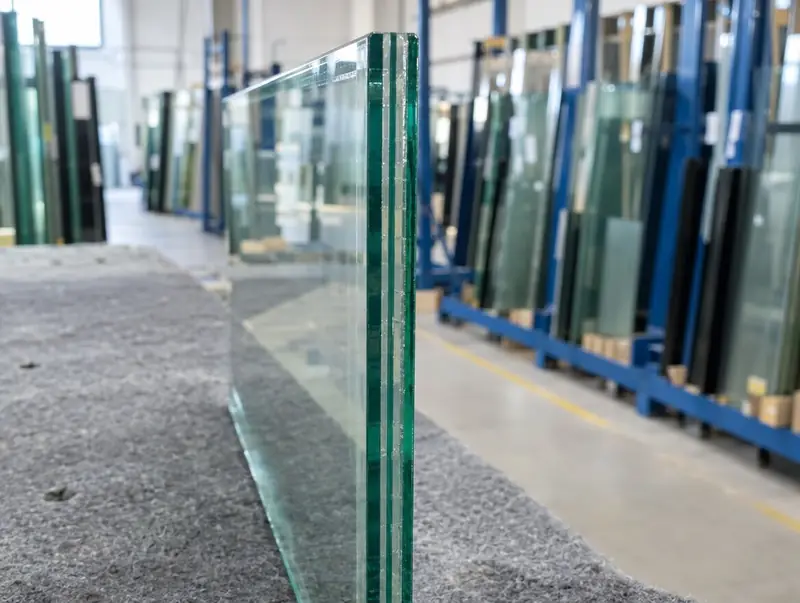
What is laminated security glass?
Laminated security glass is made by bonding two or more sheets of glass to a plastic interlayer, usually PVB, under heat and pressure. When it is struck the glass cracks but the fragments stay stuck to the interlayer, so the pane keeps filling the opening and has to be attacked again and again before anyone can get through.
Ordinary float glass breaks into sharp shards and leaves a clear hole in seconds. Laminated glass behaves differently: the interlayer stretches and holds the broken glass together, which makes it safer when people walk into it and much slower to get through when someone is trying to break in. That delay, and the noise it takes, is what puts most opportunist burglars off.
Security levels are set by the makeup of the glass, meaning the thickness of each sheet and the number and thickness of the interlayers. Under BS EN 356 a pane is rated P1A to P5A by dropping a 4.11 kg steel ball on it, and P6B to P8B by attacking it with a hammer and axe. A common 6.8 mm laminate with a 0.76 mm interlayer typically reaches P2A, while P4A is usually around 8.8 to 9.5 mm. We always quote the manufacturer's tested makeup for the class you need, with their test evidence supplied with your quote.
How much does laminated security glass cost?
Our guide range is £174 to £594 including VAT (£145 to £495 plus VAT) per pane, supplied and fitted. The exact figure depends on size, glass makeup, frame condition and access, and your fixed price is confirmed in writing after the free survey. See all glass prices.
Specification and options
- Single panes or the inner or outer pane of a sealed unit
- Classes from P1A to P5A under BS EN 356, with heavier P6B to P8B options
- PVB interlayers from 0.38 mm to 1.52 mm, or stiffer ionoplast interlayers
- Clear, low-iron, tinted, obscure and acoustic versions
- Cut to size on site or in the factory, unlike toughened glass
- Blocks most UV light, which slows fading of furniture and stock
- Edges sealed and glazed to suit timber, uPVC, aluminium and steel frames
- Breaks safely, meeting impact classes used for critical locations
Where laminated security glass is used
- Ground-floor windows that face a garden or alley
- Glazed doors where a thumb-turn lock sits behind the glass
- Shop windows and glazed shop doors
- Rooflights and overhead glazing
- Low-level glass in homes, schools and offices
What to decide before you order
Which security class
P2A suits most homes and many offices. Higher-risk shops, stockrooms and cash areas usually move up to P4A, or to the anti-bandit P6B to P8B classes.
Single pane or sealed unit
In double glazing the laminated sheet is normally the inner pane, with a toughened outer pane where safety glass is needed. Single-glazed frames take a laminated pane on its own.
Frame and rebate depth
Thicker laminates need a deeper glazing rebate and stronger beads. We check what your frames will take before anything is ordered.
Clear or special glass
Low-iron glass removes the green tint on thick panes, acoustic interlayers cut road noise, and obscure versions give privacy for bathrooms and side panels.
Rules across the UK
Safety glazing, building regulations, planning and listed building rules differ between England, Wales, Scotland and Northern Ireland. These are the points most relevant to laminated security glass; local pages show the version for your nation.
Safety glass in critical locations
In England, section 5 of Approved Document K treats glazing in doors and in side panels within 300 mm of a door edge, from floor level up to 1,500 mm, and any other glazing below 800 mm, as a critical location. Glass there should break safely, be robust, or be guarded. Laminated or toughened glass meeting BS EN 12600 class 3 is the usual answer, rising to class 2 for door and side-panel panes wider than 900 mm.
Security rules for new homes
Approved Document Q has applied to new homes in England since 1 October 2015. Easily accessible doors and windows, meaning any part within 2 m vertically of the ground or another accessible surface, should meet PAS 24 or an equivalent, and glazing in doors and in windows within 400 mm of a door should be laminated to at least BS EN 356 P1A. It does not apply when you change the glass in an existing home, although it is a sensible benchmark.
Replacing glass in an existing frame
Replacing only the glass or sealed unit in an existing frame is generally treated as a repair in England rather than notifiable building work. Replacing a whole window or door is notifiable and is normally certified through a competent person scheme or approved by building control. Either way, new glass in a critical location should still be safety glass.
How it works
Tell us what needs securing
Use the guide price tool or form, or call. Pane sizes and a few photos help us give a guide figure straight away.
Free survey
A surveyor measures each pane, checks the existing glass, frame and beads, and talks through the rating that suits the risk.
Fixed price in writing
You get a written quote listing each pane, the glass type and class, the price and the lead time. Nothing is ordered until you accept.
Made to measure and fitted
Glass is made to order and fitted by glaziers working under our contract with you, then cleaned, checked and explained.
Laminated security glass: questions
How much does laminated security glass cost?
Most single panes of laminated security glass cost from £145 to £495 plus VAT (£174 to £594 inc VAT) supplied and fitted, depending on size, thickness and class. Large shop panes cost more, and anti-bandit grades are priced separately. Your fixed price is confirmed in writing after a free survey.
Is laminated glass the same as safety glass?
Laminated glass is one type of safety glass, because it breaks safely and stays in place. Toughened glass is the other common type. Only laminated glass also gives real resistance to someone trying to break through.
What does P2A mean on laminated glass?
P2A is a class under BS EN 356. A sample has to stop a 4.11 kg steel ball dropped three times from 3 metres without the ball passing through. It is a sensible minimum for windows and doors that can be reached from the ground.
Can laminated glass be cut to size?
Yes. Unlike toughened glass, laminated glass can be cut after it is made, which helps with odd shapes and quick replacements. The edges are finished and kept dry in the frame to protect the interlayer.
Does laminated glass stop burglars completely?
No glass makes a building impossible to enter. Laminated glass makes breaking in slow, noisy and hard work, which makes the building a much poorer target for an opportunist. Higher classes and stronger frames add more delay.
Will laminated glass fit my existing windows?
Usually. A laminated pane or a sealed unit with a laminated inner pane is made to the same overall thickness as your current glass where the frame allows. We check rebate depth, beads and hinges first.
Find laminated security glass near you
Choose your county or region for local information and the rules that apply where you are.
England
- Bedfordshire
- Berkshire
- Bristol
- Buckinghamshire
- Cambridgeshire
- Cheshire
- Cornwall
- Cumbria
- Derbyshire
- Devon
- Dorset
- Durham
- East Riding of Yorkshire
- East Sussex
- Essex
- Gloucestershire
- Greater London
- Greater Manchester
- Hampshire
- Herefordshire
- Hertfordshire
- Isle of Wight
- Kent
- Lancashire
- Leicestershire
- Lincolnshire
- Merseyside
- Norfolk
- North Yorkshire
- Northamptonshire
- Northumberland
- Nottinghamshire
- Oxfordshire
- Rutland
- Shropshire
- Somerset
- South Yorkshire
- Staffordshire
- Suffolk
- Surrey
- Tyne and Wear
- Warwickshire
- West Midlands
- West Sussex
- West Yorkshire
- Wiltshire
- Worcestershire
Wales
Scotland
- Aberdeen, Aberdeenshire and Moray
- Highland
- Dundee and Angus
- Perth and Kinross
- Fife
- Edinburgh and the Lothians
- Forth Valley
- Glasgow and Clyde
- Lanarkshire
- Ayrshire
- Argyll and Bute
- Dumfries and Galloway
- Scottish Borders
- Orkney, Shetland and the Western Isles