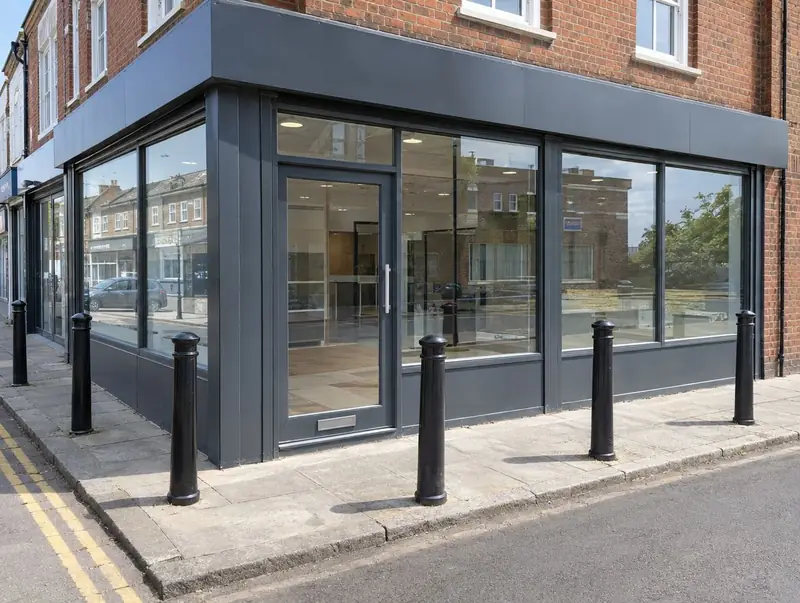
What is anti-ram-raid glazing?
Anti-ram-raid glazing is heavy laminated or anti-bandit glass fitted in strengthened, deeply rebated frames so that, if a vehicle or heavy tool hits the shopfront, the opening is not simply cleared. Glass and frames delay entry; stopping the vehicle itself needs bollards, posts or barriers in front of the shop.
Ram raids are fast: a vehicle is used to break the frontage and the stock is taken in a few minutes. No glass on its own can stop a car or van. What glazing can do is keep a battered shopfront from opening up, so that after the impact the raiders still face laminated glass bonded to a frame that has not folded, which costs them time they do not have.
A sensible scheme works in layers. Outside, tested bollards, posts or planters keep vehicles back from the glass; these are specified and priced separately and often need consent from the council or highway authority, especially on a public pavement. At the frontage, we fit anti-bandit or thick laminated glass in steel-reinforced or heavy aluminium framing with deep glass bite and secure fixings into the structure. Inside, stock can be moved back from the window at night. We survey the whole frontage and set out what each layer does.
How much does anti-ram-raid glazing cost?
Our guide range is £1,495 to £6,995 plus VAT (£1,794 to £8,394 inc VAT) per shopfront, supplied and fitted. The exact figure depends on size, glass makeup, frame condition and access, and your fixed price is confirmed in writing after the free survey. See all glass prices.
Specification and options
- Anti-bandit glass in P6B to P8B classes
- Steel-reinforced or heavy-section framing
- Deep glazing rebates and bonded or mechanical glass retention
- Fixings designed back to the structure
- Stallriser and threshold strengthening
- Advice on bollards and barriers, priced separately
- Night-time stock layout advice
- Manufacturer's test evidence supplied with your quote
Where anti-ram-raid glazing is used
- Phone, electronics and tobacco retailers
- Jewellers and pawnbrokers
- Convenience stores with cash machines inside
- Shops on corners or with open forecourts
- Premises that have already been rammed
What to decide before you order
Stop the vehicle or delay entry
Bollards and barriers stop vehicles; glass and frames delay entry afterwards. Most sites need both, and we explain which layer does what.
Consent for bollards
Bollards on the public highway need the highway authority's agreement, and forecourt barriers may need planning permission.
New frame or upgraded frame
Existing shopfront frames are rarely strong enough. Strengthened or new framing is usually part of the job.
Insurer requirements
Insurers often set conditions after a raid. Get their wording before ordering so the scheme meets it.
Rules across the UK
Safety glazing, building regulations, planning and listed building rules differ between England, Wales, Scotland and Northern Ireland. These are the points most relevant to anti-ram-raid glazing; local pages show the version for your nation.
Planning permission
Changing the glass in an existing window or shopfront does not usually need planning permission, because the building looks much the same afterwards. A new or altered shopfront, or security features added to the outside of a building, may need planning permission from the council. Bollards or barriers on the pavement need the highway authority's consent, which is normally the council.
Insurer requirements
Insurers set their own conditions for shops, offices, stock and cash, and some name a glazing class such as BS EN 356 P6B in the policy wording. Ask for that wording in writing before you order. The insurer decides whether the glass meets their policy; we provide the glass manufacturer's test evidence with the quote.
Listed buildings and conservation areas
In England, listed building consent from the council may be needed to replace historic glass such as crown or cylinder glass, or to alter glazing bars, sashes and frames. Historic England publishes guidance on traditional windows. Secondary glazing and window film are often easier to agree because they can be removed later, but the council's conservation officer makes the decision.
How it works
Tell us what needs securing
Use the guide price tool or form, or call. Pane sizes and a few photos help us give a guide figure straight away.
Free survey
A surveyor measures each pane, checks the existing glass, frame and beads, and talks through the rating that suits the risk.
Fixed price in writing
You get a written quote listing each pane, the glass type and class, the price and the lead time. Nothing is ordered until you accept.
Made to measure and fitted
Glass is made to order and fitted by glaziers working under our contract with you, then cleaned, checked and explained.
Anti-ram-raid glazing: questions
How much does anti-ram-raid glazing cost?
Anti-ram-raid glazing usually costs from £1,495 to £6,995 plus VAT (£1,794 to £8,394 inc VAT) per shopfront supplied and fitted, depending on width, glass class and framing. Bollards and barriers are priced separately. Your fixed price follows a free survey.
Can glass stop a ram raid?
No. Glass cannot stop a vehicle. Strong laminated glass in a strengthened frame delays entry after impact; bollards or barriers are what stop the vehicle reaching the glass.
Do I need permission for bollards outside my shop?
Usually. Bollards on a public pavement need the highway authority's agreement, and forecourt barriers or new shopfront framing may need planning permission. We tell you what to check.
What glass is used against ram raids?
Usually anti-bandit laminated glass in the P6B to P8B classes, held in deep-rebate, reinforced framing so the pane does not fall out when the frame is struck.
Can you strengthen my existing shopfront?
Sometimes, with reinforced mullions and better glass retention, but many frontages need new framing to make the glass upgrade worthwhile.
Should I move stock away from the window?
Yes. Keeping high-value stock away from the glass at night reduces the reward and complements the physical measures.
Find anti-ram-raid glazing near you
Choose your county or region for local information and the rules that apply where you are.
England
- Bedfordshire
- Berkshire
- Bristol
- Buckinghamshire
- Cambridgeshire
- Cheshire
- Cornwall
- Cumbria
- Derbyshire
- Devon
- Dorset
- Durham
- East Riding of Yorkshire
- East Sussex
- Essex
- Gloucestershire
- Greater London
- Greater Manchester
- Hampshire
- Herefordshire
- Hertfordshire
- Isle of Wight
- Kent
- Lancashire
- Leicestershire
- Lincolnshire
- Merseyside
- Norfolk
- North Yorkshire
- Northamptonshire
- Northumberland
- Nottinghamshire
- Oxfordshire
- Rutland
- Shropshire
- Somerset
- South Yorkshire
- Staffordshire
- Suffolk
- Surrey
- Tyne and Wear
- Warwickshire
- West Midlands
- West Sussex
- West Yorkshire
- Wiltshire
- Worcestershire
Wales
Scotland
- Aberdeen, Aberdeenshire and Moray
- Highland
- Dundee and Angus
- Perth and Kinross
- Fife
- Edinburgh and the Lothians
- Forth Valley
- Glasgow and Clyde
- Lanarkshire
- Ayrshire
- Argyll and Bute
- Dumfries and Galloway
- Scottish Borders
- Orkney, Shetland and the Western Isles