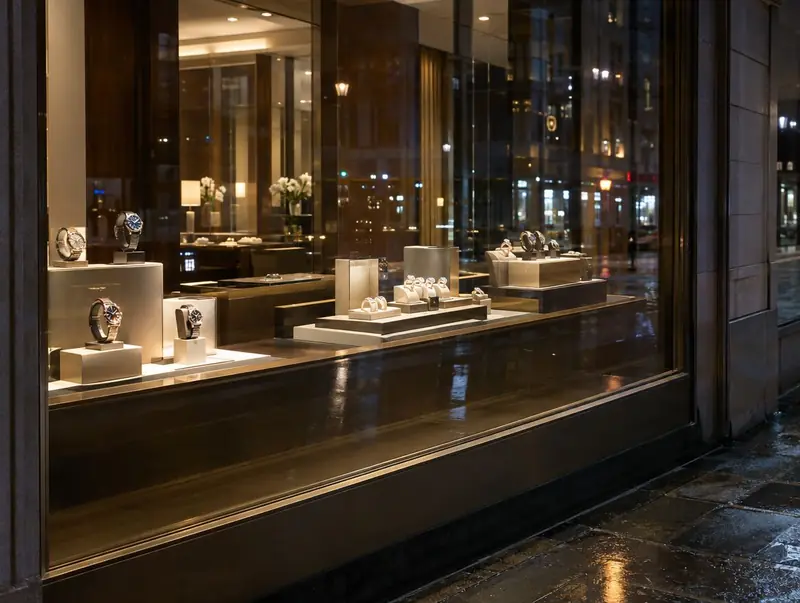
What is anti-bandit glass?
Anti-bandit glass is a heavy laminated glass built from several sheets and interlayers to resist a determined manual attack with tools. Under BS EN 356 it is classed P6B, P7B or P8B by how many hammer and axe strikes a machine needs to cut a 400 by 400 mm hole through it. The class belongs to the manufacturer's tested makeup, and their test evidence comes with your quote.
The ball-drop classes P1A to P5A show how well glass resists a heavy object thrown at it. The B classes go further and measure a sustained attack: a hammer to break the surface, then an axe to cut through the layers. P6B needs 30 to 50 strikes, P7B 51 to 70 and P8B more than 70. In practice that means minutes of loud, obvious work rather than seconds.
Anti-bandit glass is heavy and thick, often 11.5 mm for P6B and 20 mm or more for P8B depending on the manufacturer's makeup. The frame has to match it: deep rebates, strong beads fixed from the inside and a secure fixing into the structure. A thick pane in a weak frame can simply be pushed out, so we survey the framing as carefully as the glass and price both.
How much does anti-bandit glass cost?
Our guide range is £450 to £2,995 plus VAT (£540 to £3,594 inc VAT) per pane, supplied and fitted. The exact figure depends on size, glass makeup, frame condition and access, and your fixed price is confirmed in writing after the free survey. See all glass prices.
Specification and options
- BS EN 356 classes P6B, P7B and P8B
- Multi-ply makeups with several thick interlayers
- Single panes for shopfronts, screens and doors
- Can be built into a sealed unit for thermal performance
- Low-iron glass to keep thick panes clear
- Internal beads and anti-tamper fixings
- Framing upgrades where existing frames are too light
- Manufacturer's test evidence supplied with your quote
Where anti-bandit glass is used
- Jewellers, watch dealers and pawnbrokers
- Phone, electronics and designer retailers
- Pharmacies with controlled drug storage
- Cash offices and counting rooms
- Reception screens in higher-risk premises
What to decide before you order
P6B, P7B or P8B
P6B is the usual step up for high-value retail. P7B and P8B are chosen where a risk assessment or insurer points to a sustained, equipped attack.
Glass alone or glass and frame
The class only means something if the frame, beads and fixings hold the glass for as long as the glass resists. We will tell you if the frame needs replacing.
Weight and handling
Large anti-bandit panes can weigh several hundred kilograms. Fitting may need lifting equipment, extra installers and a planned slot outside trading hours.
Clarity
Thick laminates look green at the edge and slightly tinted in the face. Low-iron glass keeps displays looking true.
Rules across the UK
Safety glazing, building regulations, planning and listed building rules differ between England, Wales, Scotland and Northern Ireland. These are the points most relevant to anti-bandit glass; local pages show the version for your nation.
Insurer requirements
Insurers set their own conditions for shops, offices, stock and cash, and some name a glazing class such as BS EN 356 P6B in the policy wording. Ask for that wording in writing before you order. The insurer decides whether the glass meets their policy; we provide the glass manufacturer's test evidence with the quote.
Planning permission
Changing the glass in an existing window or shopfront does not usually need planning permission, because the building looks much the same afterwards. A new or altered shopfront, or security features added to the outside of a building, may need planning permission from the council. Bollards or barriers on the pavement need the highway authority's consent, which is normally the council.
Glazing in workplaces
Regulation 14 of the Workplace (Health, Safety and Welfare) Regulations 1992 requires windows and transparent surfaces in walls, partitions, doors and gates to be of safety material or protected against breakage where health or safety makes that necessary, and to be marked so people notice them. The employer or the person in control of the premises decides what is needed through their risk assessment.
How it works
Tell us what needs securing
Use the guide price tool or form, or call. Pane sizes and a few photos help us give a guide figure straight away.
Free survey
A surveyor measures each pane, checks the existing glass, frame and beads, and talks through the rating that suits the risk.
Fixed price in writing
You get a written quote listing each pane, the glass type and class, the price and the lead time. Nothing is ordered until you accept.
Made to measure and fitted
Glass is made to order and fitted by glaziers working under our contract with you, then cleaned, checked and explained.
Anti-bandit glass: questions
How much does anti-bandit glass cost?
Anti-bandit glass usually costs from £450 to £2,995 plus VAT (£540 to £3,594 inc VAT) per pane supplied and fitted, depending on class, size and access. Framing upgrades are priced separately where needed. Your fixed price follows a free survey.
What is the difference between anti-bandit and laminated glass?
All anti-bandit glass is laminated, but not all laminated glass is anti-bandit. The term is used for the P6B to P8B classes, which resist hammer and axe attack rather than just a dropped weight.
How thick is anti-bandit glass?
It depends on the manufacturer's makeup for each class. P6B is often around 11.5 mm and P8B commonly 20 mm or more. We quote the tested makeup for the class you need.
Can anti-bandit glass go into my existing shopfront?
Sometimes. Many older shopfront frames are too shallow or too light for thick glass. We check the rebate depth, bead strength and fixings, and price new framing if the existing frame would be the weak point.
Does my insurer require anti-bandit glass?
Some insurers name a glass class for certain stock or cash limits. Send us the policy wording and we will quote to it. The insurer decides whether a product meets their conditions.
Is anti-bandit glass the same as bullet-resistant glass?
No. Anti-bandit glass is tested against manual attack under BS EN 356. Bullet-resistant glass is tested against firearms under BS EN 1063, and is thicker and heavier again.
Find anti-bandit glass near you
Choose your county or region for local information and the rules that apply where you are.
England
- Bedfordshire
- Berkshire
- Bristol
- Buckinghamshire
- Cambridgeshire
- Cheshire
- Cornwall
- Cumbria
- Derbyshire
- Devon
- Dorset
- Durham
- East Riding of Yorkshire
- East Sussex
- Essex
- Gloucestershire
- Greater London
- Greater Manchester
- Hampshire
- Herefordshire
- Hertfordshire
- Isle of Wight
- Kent
- Lancashire
- Leicestershire
- Lincolnshire
- Merseyside
- Norfolk
- North Yorkshire
- Northamptonshire
- Northumberland
- Nottinghamshire
- Oxfordshire
- Rutland
- Shropshire
- Somerset
- South Yorkshire
- Staffordshire
- Suffolk
- Surrey
- Tyne and Wear
- Warwickshire
- West Midlands
- West Sussex
- West Yorkshire
- Wiltshire
- Worcestershire
Wales
Scotland
- Aberdeen, Aberdeenshire and Moray
- Highland
- Dundee and Angus
- Perth and Kinross
- Fife
- Edinburgh and the Lothians
- Forth Valley
- Glasgow and Clyde
- Lanarkshire
- Ayrshire
- Argyll and Bute
- Dumfries and Galloway
- Scottish Borders
- Orkney, Shetland and the Western Isles