Anti-bandit glass in Edinburgh and the Lothians: what will it cost?
As a guide, allow £450 to £2,995 plus VAT (£540 to £3,594 inc VAT) per pane for anti-bandit glass in Edinburgh and the Lothians, supplied and fitted. Size, glass makeup, access and frame condition move the price, which is confirmed in writing after the free survey.
Anti-bandit glass is a heavy laminated glass built from several sheets and interlayers to resist a determined manual attack with tools. Under BS EN 356 it is classed P6B, P7B or P8B by how many hammer and axe strikes a machine needs to cut a 400 by 400 mm hole through it. The class belongs to the manufacturer's tested makeup, and their test evidence comes with your quote.
What goes into anti-bandit glass
- Multi-ply makeups with several thick interlayers
- BS EN 356 classes P6B, P7B and P8B
- Can be built into a sealed unit for thermal performance
- Internal beads and anti-tamper fixings
- Manufacturer's test evidence supplied with your quote
- Single panes for shopfronts, screens and doors
Covering Edinburgh and the Lothians
We can arrange surveys and fitting anywhere in Edinburgh and the Lothians, including Edinburgh and Livingston. Dates depend on installer availability. Choose your town below for local details.
Windows and shopfronts in Edinburgh's World Heritage centre are closely controlled, while Livingston, Musselburgh and the other Lothian towns have newer estates, offices and retail parks.
Typical settings for anti-bandit glass:
- Reception screens in higher-risk premises
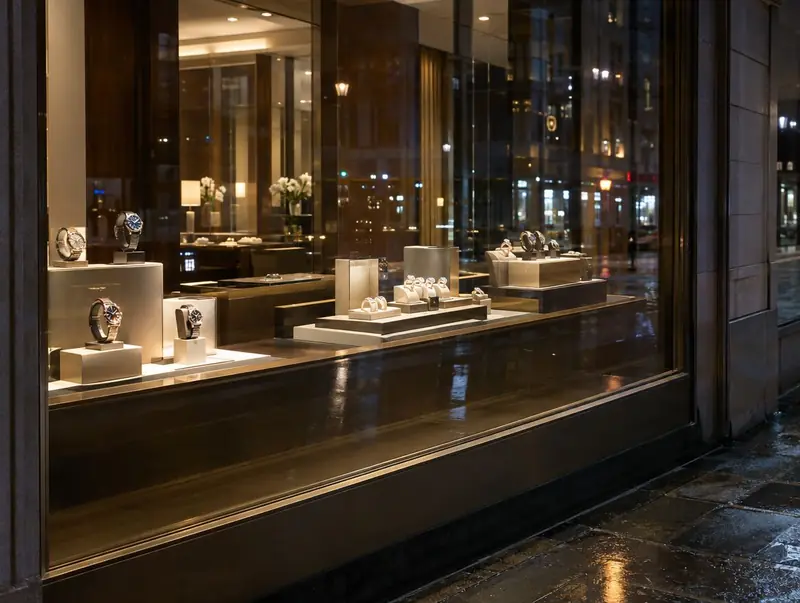
- Jewellers, watch dealers and pawnbrokers
- Phone, electronics and designer retailers
- Cash offices and counting rooms
Towns in Edinburgh and the Lothians
Getting the right glass for your building
Clarity
Thick laminates look green at the edge and slightly tinted in the face. Low-iron glass keeps displays looking true.
P6B, P7B or P8B
P6B is the usual step up for high-value retail. P7B and P8B are chosen where a risk assessment or insurer points to a sustained, equipped attack.
What the rules say in Scotland
Insurer requirements
Insurers set their own conditions for Scottish premises, stock and cash, and may name a glazing class such as BS EN 356 P6B. Get the wording in writing before you order. The insurer decides whether the glass meets their policy; we supply the manufacturer's test evidence with the quote.
Planning permission
Under the Scottish planning system the council decides whether a new or altered shopfront needs planning permission; changing the glass in an existing frame usually does not. Bollards or barriers in a road or footway need consent from the roads authority, which is normally the council.
How it works
- Guide price online or by phone
- Survey in Edinburgh and the Lothians
- Accept the fixed quote
- Fitted by glaziers working under our contract
Anti-bandit glass in Edinburgh and the Lothians: questions
Which towns in Edinburgh and the Lothians do you cover?
We can arrange work anywhere in Edinburgh and the Lothians, including Edinburgh, Livingston, Musselburgh, Bathgate and Dalkeith, and in other towns across the area.
Does my insurer require anti-bandit glass?
Some insurers name a glass class for certain stock or cash limits. Send us the policy wording and we will quote to it. The insurer decides whether a product meets their conditions.
Is anti-bandit glass the same as bullet-resistant glass?
No. Anti-bandit glass is tested against manual attack under BS EN 356. Bullet-resistant glass is tested against firearms under BS EN 1063, and is thicker and heavier again.
How thick is anti-bandit glass?
It depends on the manufacturer's makeup for each class. P6B is often around 11.5 mm and P8B commonly 20 mm or more. We quote the tested makeup for the class you need.
Other glazing in Edinburgh and the Lothians
- Security glass for home windows
- Toughened safety glass
- Security window film
- Patio and bifold door security glass
- Glazing bead security upgrades
- Laminated glass retrofit
Tell us about the glazing and we will come back with a guide price.