What is commercial reglazing?
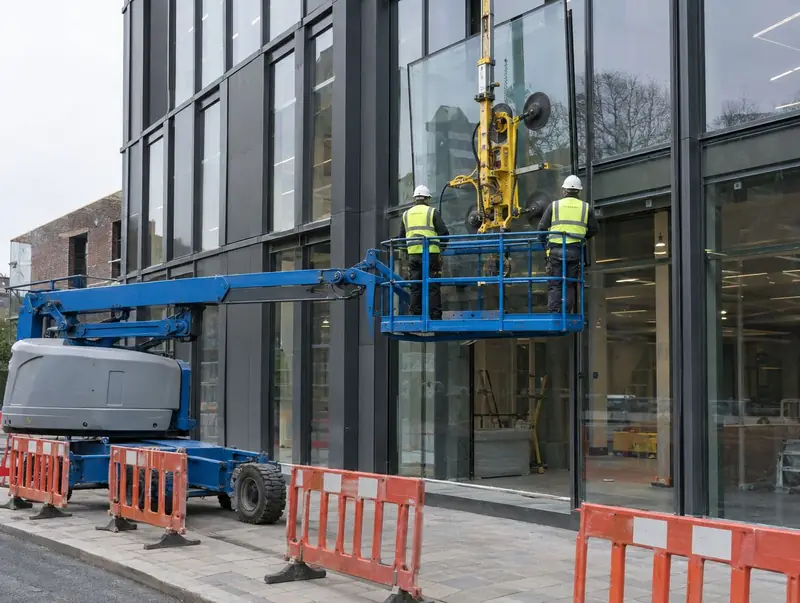
Commercial reglazing is the replacement of glass in office facades, shopfronts, curtain walling and internal screens, whether it is damaged, misted, unsafe or being upgraded. It often involves large panes, access equipment and work planned around a building that stays open.
Commercial glass fails for many reasons: impact damage, failed sealed units, spontaneous breakage of toughened glass, or simply glass that no longer meets current safety or security needs. Reglazing replaces it within the existing framing system, matching coatings and tints as closely as possible and upgrading to laminated or safety glass where that makes sense.
Large panes are heavy and awkward, so access and lifting are planned from the start: scaffold towers, mobile elevating work platforms or vacuum lifters, pavement barriers, and any permits needed for working on or over the public highway. We survey the panes, check the framing system and gaskets, and give a written method and price before work begins. Where coated or tinted glass has to be matched, we explain if an exact match is not possible.
How much does commercial reglazing cost?
Our guide range is £395 to £2,495 plus VAT (£474 to £2,994 inc VAT) per pane, supplied and fitted. The exact figure depends on size, glass makeup, frame condition and access, and your fixed price is confirmed in writing after the free survey. See all glass prices.
Specification and options
- Replacement of single panes and sealed units
- Upgrades to laminated or toughened safety glass
- Matching tints and solar control coatings where possible
- Vacuum lifters, towers and boom lifts
- Pavement barriers and highway permits arranged
- Work out of hours where needed
- Gasket and bead renewal
- Written method statement and price
Where commercial reglazing is used
- Office facades and curtain walling
- Shopfronts and showrooms
- Schools, libraries and council buildings
- Internal glazed screens and partitions
- Blocks of flats with communal glazing
What to decide before you order
Match or upgrade
Like-for-like keeps the facade consistent. Upgrading to laminated or safety glass is often worth it at ground level.
Coated glass matching
Older solar control glass may no longer be made. We source the closest match and tell you if it will look slightly different.
Access
Ground-level panes may need only towers; upper panes may need a boom lift and highway permits. We plan and price access up front.
Keeping the building open
Out-of-hours work and phased replacement keep disruption low.
Rules across the UK
Safety glazing, building regulations, planning and listed building rules differ between England, Wales, Scotland and Northern Ireland. These are the points most relevant to commercial reglazing; local pages show the version for your nation.
Glazing in workplaces
Regulation 14 of the Workplace (Health, Safety and Welfare) Regulations 1992 requires windows and transparent surfaces in walls, partitions, doors and gates to be of safety material or protected against breakage where health or safety makes that necessary, and to be marked so people notice them. The employer or the person in control of the premises decides what is needed through their risk assessment.
Safety glass in critical locations
In England, section 5 of Approved Document K treats glazing in doors and in side panels within 300 mm of a door edge, from floor level up to 1,500 mm, and any other glazing below 800 mm, as a critical location. Glass there should break safely, be robust, or be guarded. Laminated or toughened glass meeting BS EN 12600 class 3 is the usual answer, rising to class 2 for door and side-panel panes wider than 900 mm.
Planning permission
Changing the glass in an existing window or shopfront does not usually need planning permission, because the building looks much the same afterwards. A new or altered shopfront, or security features added to the outside of a building, may need planning permission from the council. Bollards or barriers on the pavement need the highway authority's consent, which is normally the council.
How it works
Tell us what needs securing
Use the guide price tool or form, or call. Pane sizes and a few photos help us give a guide figure straight away.
Free survey
A surveyor measures each pane, checks the existing glass, frame and beads, and talks through the rating that suits the risk.
Fixed price in writing
You get a written quote listing each pane, the glass type and class, the price and the lead time. Nothing is ordered until you accept.
Made to measure and fitted
Glass is made to order and fitted by glaziers working under our contract with you, then cleaned, checked and explained.
Commercial reglazing: questions
How much does commercial reglazing cost?
Commercial reglazing usually costs from £395 to £2,495 plus VAT (£474 to £2,994 inc VAT) per pane supplied and fitted, depending on size, glass specification and access. Lifting equipment and permits are included in the written price after a free survey.
Can you match our existing tinted glass?
Usually closely. Some older coatings are no longer made, so we source the nearest match and explain any difference before ordering.
Do you work on curtain walling?
Yes, replacing glass within existing curtain wall and shopfront systems, subject to a survey of the framing and gaskets.
Can work be done out of hours?
Yes. Many commercial reglazing jobs are done early, late or at weekends where an installer is available.
Should we upgrade to laminated glass while reglazing?
At ground level and in doors, often yes. It adds safety and security for a modest extra cost.
Who arranges permits for lifts on the pavement?
We do, as part of planning the job, and include the cost in the price.
Find commercial reglazing near you
Choose your county or region for local information and the rules that apply where you are.
England
- Bedfordshire
- Berkshire
- Bristol
- Buckinghamshire
- Cambridgeshire
- Cheshire
- Cornwall
- Cumbria
- Derbyshire
- Devon
- Dorset
- Durham
- East Riding of Yorkshire
- East Sussex
- Essex
- Gloucestershire
- Greater London
- Greater Manchester
- Hampshire
- Herefordshire
- Hertfordshire
- Isle of Wight
- Kent
- Lancashire
- Leicestershire
- Lincolnshire
- Merseyside
- Norfolk
- North Yorkshire
- Northamptonshire
- Northumberland
- Nottinghamshire
- Oxfordshire
- Rutland
- Shropshire
- Somerset
- South Yorkshire
- Staffordshire
- Suffolk
- Surrey
- Tyne and Wear
- Warwickshire
- West Midlands
- West Sussex
- West Yorkshire
- Wiltshire
- Worcestershire
Wales
Scotland
- Aberdeen, Aberdeenshire and Moray
- Highland
- Dundee and Angus
- Perth and Kinross
- Fife
- Edinburgh and the Lothians
- Forth Valley
- Glasgow and Clyde
- Lanarkshire
- Ayrshire
- Argyll and Bute
- Dumfries and Galloway
- Scottish Borders
- Orkney, Shetland and the Western Isles