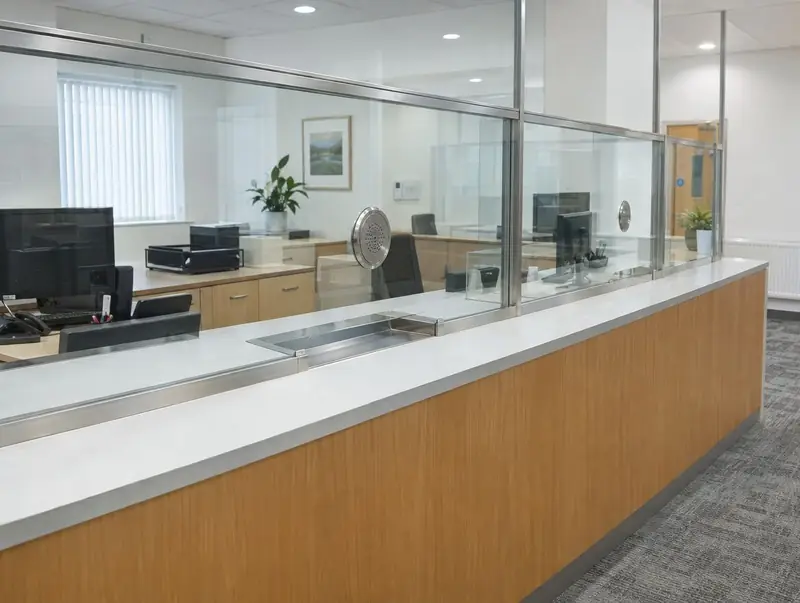
Bullet-resistant glass in Plymouth: what will it cost?
As a guide, bullet-resistant glass costs £995 to £2,995 plus VAT (£1,194 to £3,594 inc VAT) per m². Because work in Plymouth is arranged individually, we confirm the full price, including any travel, in writing first.
Bullet-resistant glass is a thick laminated composite of glass, interlayers and often polycarbonate that is tested to stop specific firearms under BS EN 1063. The class, from BR1 to BR7 plus the shotgun classes SG1 and SG2, describes the weapon and ammunition the glass has been shown to stop. Ratings belong to the manufacturer's tested product, and their test evidence comes with your quote.
What goes into bullet-resistant glass
- Single panes or sealed units for external use
- BS EN 1063 classes BR1 to BR7 and SG1 or SG2
- Manufacturer's test evidence supplied with your quote
- Matching rated frames, joints and transaction trays
- NS (no-splinter) makeups for staff working close to the glass
- Speech panels and deal trays that keep the protection continuous
Fitting in Plymouth
Work in Plymouth (PL1) is arranged individually. Send your postcode, sizes and a photo, and we will confirm what is possible and when.
Devon spans Exeter's Georgian and post-war centre, Plymouth's rebuilt 1950s shopping streets and waterfront offices, and seaside towns where sea air is hard on window frames and seals.
Typical settings for bullet-resistant glass:
- Security gatehouses and control rooms
- Petrol station night-pay windows
- Secure reception points in public buildings
- Bank, building society and post office counters
Getting the right glass for your building
S or NS
If staff sit within arm's reach of the glass, specify NS so that no splinters come off the inside face.
The rest of the screen
Frames, joints, trays and the wall below the counter must give matching protection, or the weakest part decides the real level.
What the rules say in England
Planning permission
Changing the glass in an existing window or shopfront does not usually need planning permission, because the building looks much the same afterwards. A new or altered shopfront, or security features added to the outside of a building, may need planning permission from the council. Bollards or barriers on the pavement need the highway authority's consent, which is normally the council.
Insurer requirements
Insurers set their own conditions for shops, offices, stock and cash, and some name a glazing class such as BS EN 356 P6B in the policy wording. Ask for that wording in writing before you order. The insurer decides whether the glass meets their policy; we provide the glass manufacturer's test evidence with the quote.
How it works
- Send sizes, photos and your postcode
- We confirm what is possible and when
- Fixed price in writing
- Glass made, delivered and fitted
Bullet-resistant glass in Plymouth: questions
Can you work in Plymouth?
Work in Plymouth is arranged individually because of travel. Send your postcode and details and we will confirm what is possible.
Can any glass stop every bullet?
No. Glass is tested to resist particular weapons and ammunition, which is why it is called bullet-resistant and given a BS EN 1063 class rather than described as stopping everything.
What does NS mean on bullet-resistant glass?
NS means no splinters came off the protected face during the test. S means some fragments did. NS is the safer choice where people sit close behind the glass.
How thick is bullet-resistant glass?
It ranges from around 20 mm for lower handgun classes to well over 50 mm for rifle classes, depending on the manufacturer's makeup and whether polycarbonate is used.
Other glazing in Plymouth
- Display case security glass
- Security glazed doors and screens
- Security secondary glazing
- Laminated glass retrofit
- Counter and reception security screens
- Kiosk and booth security glazing
Send sizes and photos with the form, or call 0800 088 6248.